Linda Loh's QUIVER exhibition emerges from her studio residency at invisible art space in May 2026 and is an iteration of previous works exploring the orb form. Loh notes: "The orbs are restless, quivering representations of luminous circular forms, existing and not existing, hovering in their own version of space. Extending the recurring themes of light, circles and blurred boundaries, the opportunity to access multiple screens enabled the integration of various versions, culminating in an abstraction of ideas informing the work: multiplicity, “all at once,” entanglement, parallel play, infinity, forever, symbols, ascension, “self” and more." It is Loh's first solo exhibition in Sydney and the first time all of her video and digital-based orbs have been shown at once.
Orbs can be seen in both analog and digital photography as transparent, circular phenomena appearing unexpectedly within the photograph. There is debate over what causes them — is it dirt or reflections of light on the camera's lens or flash, or something more paranormal [1][12].
Orbs have a philosophical history also — Plato's Symposium features orbs: Aristophanes’ speech mentions that original human beings were spherical in form, with four arms, four legs and two faces looking in opposite directions [3]. Zeus was jealous of their strength and cut them into two, and they've been trying to return to their original form as One since then, only succeeding through love [3][2]. The circular form of the orb has indicated Oneness in many cultures throughout history [4].
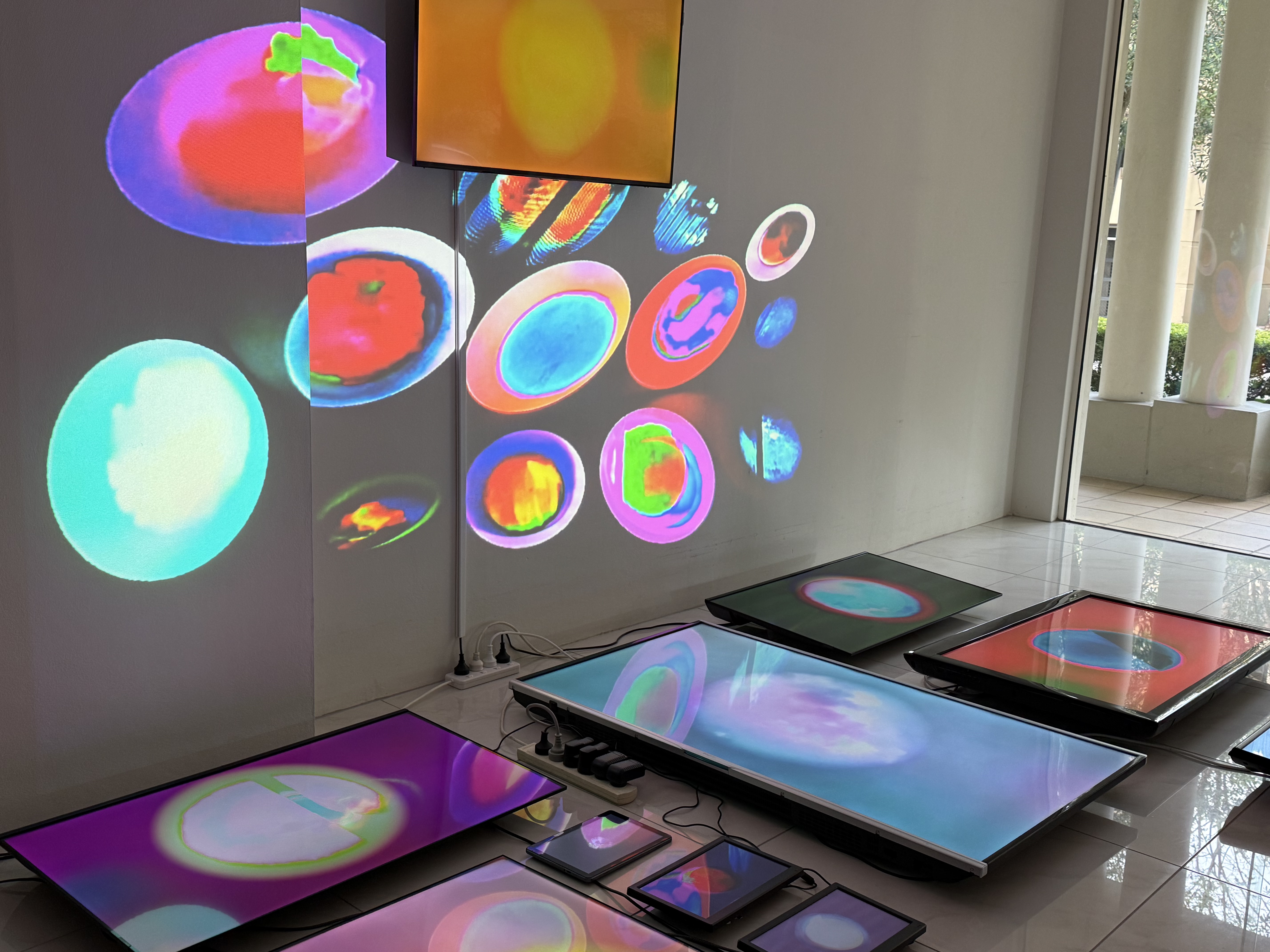
Loh’s orbs glow and pulsate light emitted from the darkness of the black screens. One screen is mounted at eye height on the wall, bathed in the light from a projector. Ten screens of various dimensions, from 12" to 52", are placed on the gallery floor, reminiscent of Richard Serra's Casting (1969) work, lifting the installation beyond a purely pictorial object [5]. Loh's screens are placed in both vertical and horizontal orientation on the floor adjacent to the wall and horizontally on the wall, which extends Serra's horizontal floor layout. Circular reflections fill the floor gaps between the display devices. The orbs are beautiful to look at, the colours are harmonious and they fit within what Peter Schjeldahl calls Baudelaire's definition of beauty as a "spark between something fleeting and something timeless" [6] in both concept and visual aspects. Loh's light-filled orbs quiver, as the exhibition title suggests. Circular patterns of colour, oscillating fields of light-based electromagnetic frequencies create space within the installation. This work is one of pure light, with the screens emitting light from the electronics within. It's a sharp contrast to traditional paintings where layers of paint cover the canvas, representing light within the frame.
Scientific research on light shows that like wind, light can push objects in its path [7], it creates movement. Loh's orbs are activated, the wisps of colour move slowly around the form, and pulsate like the activation of energy in the electrons themselves. We're seeing frequencies of light moving at its most basic level. Light has been studied throughout time, from Euclid of Alexandria in his c. 300 BC Optica record of observations [8], to Isaac Newton's 1704 book Opticks and Michael Faraday and James Clerk Maxwell's work on the electromagnetic spectrum in the 1800s through to Werner Heisenberg's self-titled Heisenberg Uncertainty Principle effectively noting that "existence at the quantum level seems to be metaphysical rather than material" [9]. Karen Barad notes that matter and meaning are entangled at the atomic level and cannot be separated [10]. We're seeing light as consciousness, at the quantum scale [11] imagined by Loh's orbs. These lights are both borderless in their reflections and contained within their screens.
-- by Kath O'Donnell, May 2026
References
Barad, Karen Michelle. 2007. Meeting the Universe Halfway : Quantum Physics and the Entanglement of Matter and Meaning. Duke University Press. https://doi.org/10.1515/9780822388128.
Invisible Art Space. 2026. Invisible Art Space. Accessed on 25 May, https://www.invisibleart.space.
Krauss, Rosalind. 1999. A Voyage on the North Sea - Art in the Age of the Post-Medium Condition. London: Thames and Hudson. https://monoskop.org/log/?p=7009.
Linda Loh. 2026. Linda Loh. Accessed on 25 May, https://lindaloh.com.
Merillat, Christian. 1997. The Gnostic Apostle Thomas: "Twin" of Jesus? The Gnostic Society Library. http://www.gnosis.org/thomasbook.
Pickering, John, and Hall, Katie. 2015. Orbs and Beyond : Communications and Revelations from Another Reality. New York: John Hunt Publishing Limited. ProQuest Ebook Central. https://ebookcentral.proquest.com/lib/qut/detail.action?docID=1964084.
Plato. 1999. The Symposium. Penguin Books (Great Ideas). Translated by Christopher Gill and Desmond Lee.
Schjeldahl, Peter. 2019. Hot, Cold, Heavy, Light, 100 Art Writings 1988-2018. New York: Abrams Press. Kindle eBook edition.
Underwood, Sandra. 2009. Orbs, Lightwaves, and Cosmic Consciousness. Bloomington, Indiana: Xlibris.
Footnotes
[1] (Pickering and Hall 2015, 15-28)
[2] (Merillat 1997, 15-16)
[3] (Plato 1999, 26-27)
[4] (Pickering and Hall 2015, 115)
[5] (Krauss 1999, 26). Image of Serra’s Casting (1969) shown in Krauss.
[6] (Schjeldahl 2019, 376)
[7] (Pickering and Hall 2015, 25)
[8] (Pickering and Hall 2015, 129)
[9] (Pickering and Hall 2015, 129-132)
[10] (Barad 2007, 20)
[11] (Pickering and Hall 2015, 114)
[12] (Underwood 2009, 137-9)